Hand tools

Stanley No. 4 vs No. 5 vs No. 5½

The No. 4 is a 9-inch smoothing plane, the No. 5 a 14-inch jack plane, and the No. 5½ a heavier 15-inch jack with a wider iron. Experts split on the first plane to buy: Patrick Leach and others say the No. 5 because it can do most jobs; Paul Sellers uses a No. 4 for most of his work.

By HeirloomID editorsUpdated 24 October 20263 min read7 sources
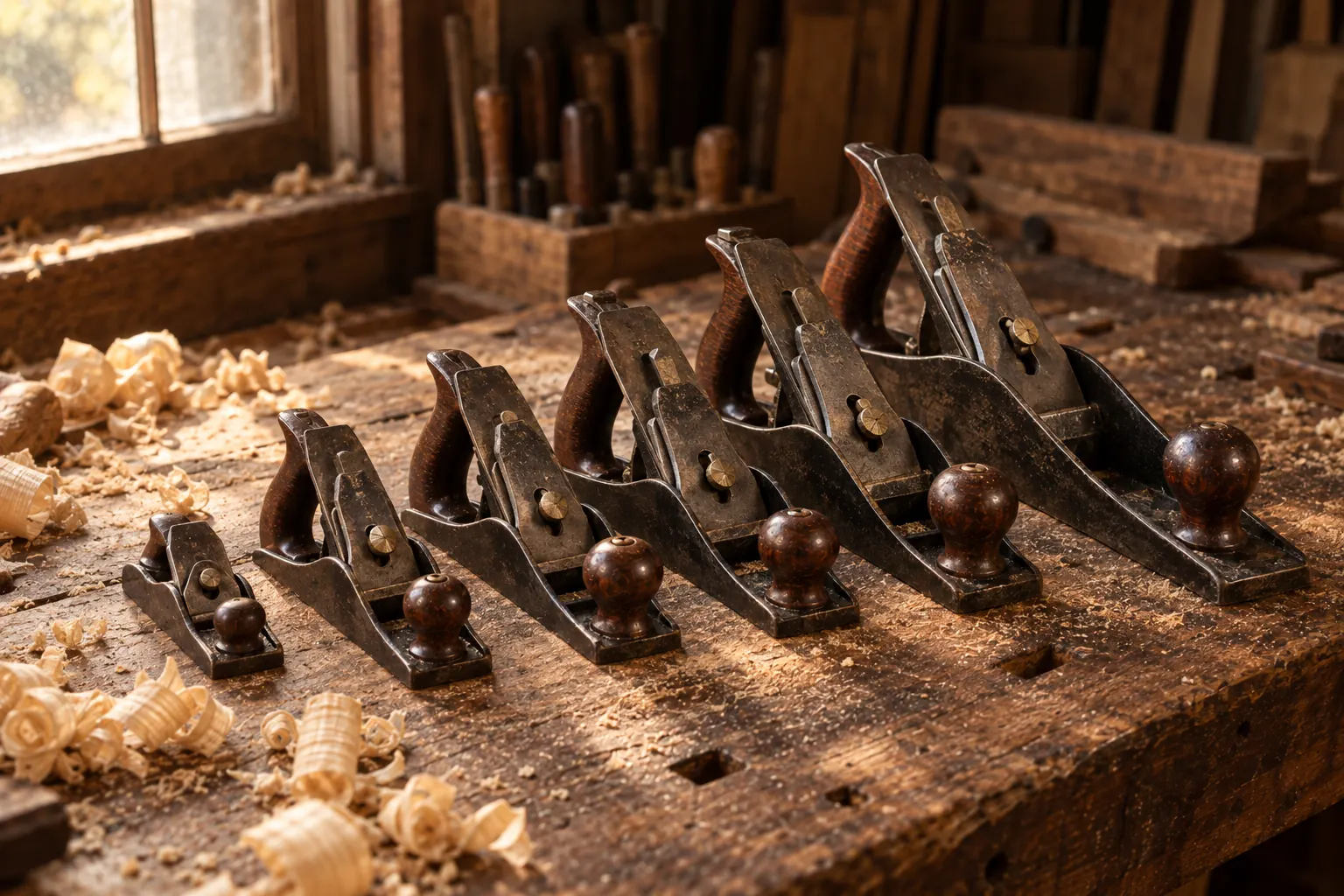
A row of old bench planes of increasing size on a workbench
Illustrative image

Key points

  • No. 4: 9 in, 2 in iron, about 3¾ lb.
  • No. 5: 14 in, 2 in iron, about 4¾ lb.
  • No. 5½: 15 in, 2¼–2⅜ in iron, about 6¾ lb, made 1898–1958.
  • Leach: the No. 5 is “the most useful of all the bench planes”.
  • Sellers: the No. 4 does “99% of the work”.

ComparisonSide by side

No. 4No. 5No. 5½
TypeSmoothingJackWide jack
Length9 in14 in15 in
Iron width2 in2 in2¼ in (2⅜ in from 1939)
Weight3¾ lb4¾ lb6¾ lb
Best atFinal smoothing, small workAll-round: flattening, edges, rough workHeavier stock, wider surfaces

Dimensions from Patrick Leach’s Blood & Gore; Handplane Central gives a 2⅜ in iron for the 5½.

First planeWhich plane should you buy first?

Leach calls the No. 5 the most useful of all the bench planes and a very good plane on which to learn technique. Matt Vanderlist, quoted by The Wood Whisperer, suggests a block plane first and, for a single bench plane, the No. 5, which can be tuned to act as a smoother. Paul Sellers, by contrast, makes the No. 4 his first choice and says he uses it for 99% of his work. If you will flatten and joint rough boards, start with a 5; if you mostly smooth prepared stock, a 4.

BuyingBuying a vintage No. 4 or No. 5

Both were made in huge numbers, so good users are affordable; Handplane Central lists average prices for corrugated versions in the tens of dollars. Check for cracks (especially at the cheeks and mouth), a complete frog and lateral lever, and an iron with life left. See our pages for the No. 4 and No. 5, what affects value, and how to set one up.

QuestionsFrequently asked questions

Is a No. 4 or No. 5 plane better?

Neither: the No. 5 is more versatile for rough and general work, the No. 4 better for final smoothing.

What is a 5½ plane used for?

It is a wider, heavier jack plane for rougher work and wider surfaces.

How long is a Stanley No. 5?

About 14 in.

Can a jack plane be used as a smoother?

Yes, with a sharp, lightly cambered iron and a fine setting.

ReferencesSources

These are the pages and manuals the facts in this article come from. Where they disagree, we say so in the text.

  1. supertool.com/StanleyBG/stan1.htm
  2. www.handplane.com/76/stanley-no-5-12-plane
  3. thewoodwhisperer.com/articles/planes-for-the-beginner
  4. paulsellers.com/2012/12/on-the-stanley-4-12-bench-smoothing-plane-and-others
  5. paulsellers.com/2015/07/stanley-4-smoothing-plane-prices-continue-to-rise
  6. www.handplane.com/82/stanley-no-4-c-smooth-plane
  7. www.handplane.com/85/stanley-no-5-c-plane

Published 24 October 2026 · Written and fact-checked by the HeirloomID editors. Spotted an error? Tell us.
Keep reading

More from the blog

A plane iron in a honing guide being sharpened on a waterstone
Illustrative image

Hand tools · 3 min read

How to sharpen a hand plane iron

Sharpen a bench plane blade: flatten the back, grind a 25° bevel, hone a 30° microbevel through 1000, 4000 and 8000 grit, and use the ruler trick on pitted backs. Plus camber for jack and smoothing planes.

Read the article
A row of vintage hand planes of different sizes with a small block plane and a rabbet plane on a workbench
Illustrative image

Hand tools · 3 min read

Types of hand planes and Stanley bench plane sizes

The types of hand planes explained: smoothing, jack, fore and jointer bench planes (Stanley No. 1 to No. 8 with lengths and widths), block planes, rabbet, plough, router, combination and scraper planes, and Bailey vs Bed Rock.

Read the article
Hands adjusting a vintage cast-iron bench plane on a workbench with curly wood shavings
Illustrative image

Hand tools · 3 min read

How to restore and tune a vintage hand plane

Restore and set up an old Stanley or Bailey-pattern hand plane: derust gently, flatten the sole, set the frog and mouth, fit the chipbreaker close to the edge, sharpen the iron and adjust depth and lateral.

Read the article
Antique wooden moulding planes and a beech smoothing plane on an old workbench
Illustrative image

Hand tools · 3 min read

Antique wooden hand planes: identify, date and use

How to identify and date antique wooden planes (moulding planes, try planes, smoothers) from maker’s marks, length, wood and chamfers, what Stanley transitional planes are, and which wooden planes are valuable.

Read the article
Vintage hand planes laid out on an antique dealer’s table
Illustrative image

Hand tools · 3 min read

Stanley plane value: what makes an old plane worth money?

What your Stanley plane is worth depends on the model number, type (age), rarity, condition, japanning and original parts. Which Stanleys are rare (No. 1, No. 2, some Bed Rocks), and how to check sold prices.

Read the article
An antique hand saw with a carved apple-wood handle being cleaned on a workbench, with a two-man crosscut saw on the wall
Illustrative image

Hand tools · 3 min read

Disston saw value and restoration

How to tell what an old Disston hand saw is worth (medallion, model, handle, etch, condition), how to remove rust without losing the etch, refinish the handle and sharpen it, plus two-man crosscut saws.

Read the article

Date your Singer in seconds

Enter the serial number from the machine bed for the year and factory.