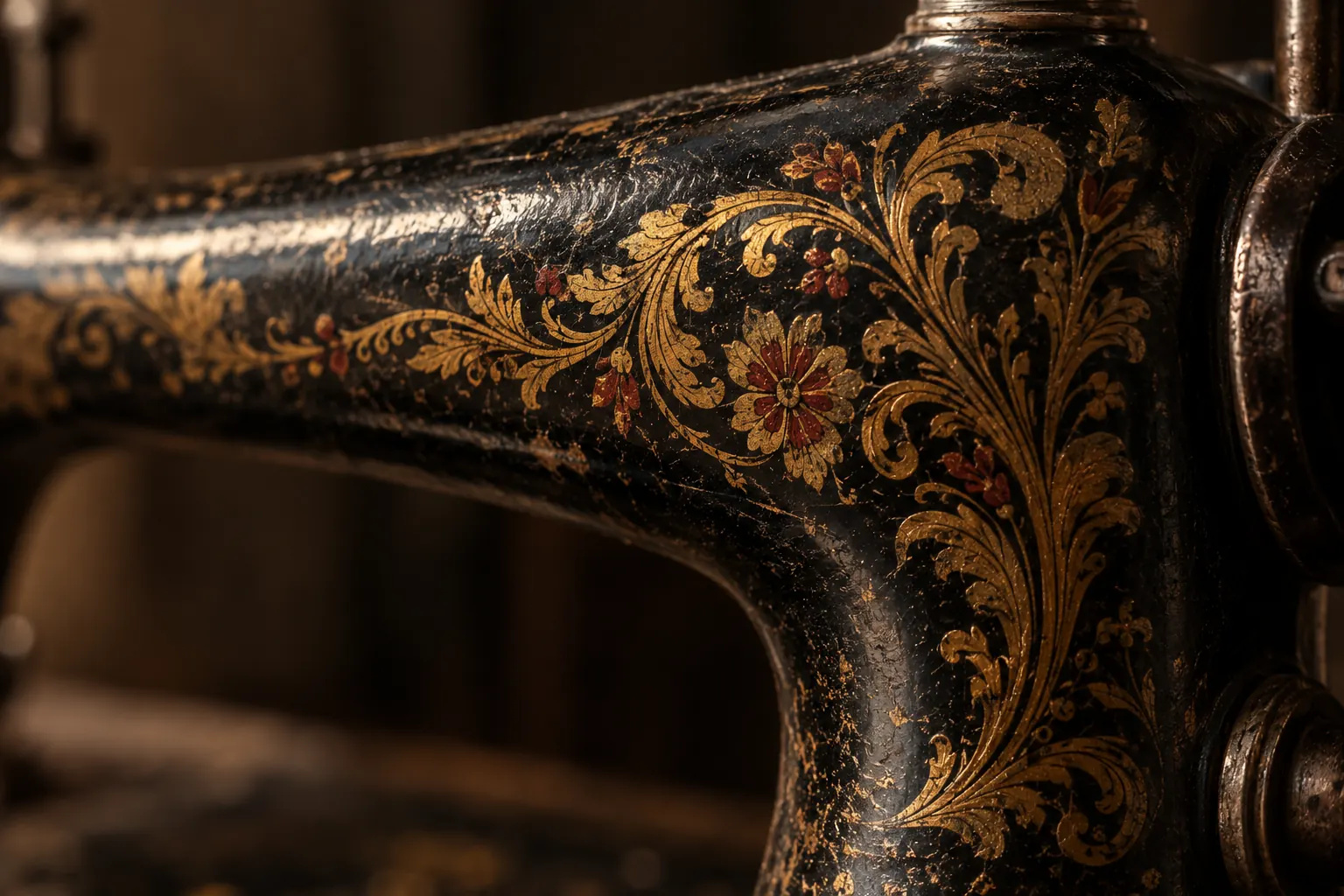
Start hereHow to use decals to identify a Singer
Singer’s gold transfers changed over the decades, so they help confirm a machine’s age and show whether its finish is original. They are a cross-check, not a date: patterns like the Sphinx ran for over 60 years and on several models. Date the machine with its serial number, identify the model by its bobbin, then check that the decals fit both.
Most decal names are collectors’ names. singersewinginfo says Singer did not officially name its patterns; ISMACS records official names for a few, such as “Scroll (red)” for the Red Eye.
Most searchedThe Red Eye Singer
The Red Eye is the decal of the American Singer 66. ISMACS calls it officially “Scroll (red)”, a development of earlier scroll designs with copious red and green, dated 1902 to about 1920 on the 66-1. Its decal index gives 1902–1923. Sewalot says the design does look like it has exotic eyes, and shows Red Eye 66s from about 1930 and 1937, so Sources vary on when it ended.
- Model: the 66, with a drop-in Class 66 bobbin under a slide plate.
- Early 66-1 clue: a back-clamping presser foot, which ISMACS calls exclusive to the 66-1. Later 66s have side-clamping feet.
- Not on Scottish 66Ks: British machines used the Lotus, then the Sphinx, then a plain gold decal.
Decal finderWhich decals could my machine have?
Choose your model to see the decals recorded on it. Years are as given by ISMACS unless noted.
Red Eye
1902–c.1920 · Scroll (red)
Red and green scrollwork that looks like a pair of eyes on the arm. The decal of the US-made 66-1. ISMACS’s index extends it to 1923, and sewalot shows examples from about 1930.
Sphinx / Memphis
1891–1950s · #15 (Sphinx)
Egyptian sphinx motifs. The longest-running Singer decal, so on its own it dates nothing. A green version and an ‘Indian Sphinx’ appeared in 1956.
Lotus (green)
1907–c.1920 · Egyptian (green)
The decal of the first Kilbowie 66Ks. Sewalot says it was also used in America for a while.
Brown Lotus
1902–1925 · Needlebar #26a
A brown variant of the Lotus recorded on early 66s from both sides of the Atlantic.
Tiffany / Gingerbread
c.1898–1930 · Needlebar #30
Intricate floral gold patterns. A 27K version from 1897 marks Queen Victoria’s Diamond Jubilee.
Filigree
1911–1940s
Delicate scrollwork and ornate detail. An ‘Indian Star’ variant was used on the 99K from 1926 to 1948.
Victorian
c.1885–1940
Gold Victorian ornament, with later gold, dark (1920) and blue (1917) variants.
Ottoman Carnations
c.1885–1913 · Design D15220
Designed about 1884 by George Alfred Squire: a carnation-like main flower, small buttercups and interlaced stems with buds.
Persian
1894–1903 · Needlebar #17
An 1890s decal recorded on the Model 27.
Pheasant
c.1890–1915
Listed by ISMACS on late Victorian and Edwardian machines.
Celtic Chain / Knot
1933–1953 · Needlebar #38
Interlaced Celtic bands on early Featherweights. ISMACS lists Celtic Knot separately from the 1940s.
Paperclips
1935–1950s
Geometric gold links. Also applied to refurbished machines, even models made before the decal existed.
Prism
1952–1960 · Needlebar #43
Later geometric decals. Some decal sellers call the 1953–61 Featherweight set “gold paperclip”.
Wrinkle finish “Godzilla”
c.1939–1953 · Set #506
A crinkled black finish, not a decal: logos only, no bed-edge transfers. Dates differ between ISMACS (1930s–40s) and singersewinginfo (c.1941–53).
FactoriesUS and Scottish machines differ
Kilbowie in Scotland made the 66K from 1907 to 1939, while US production of the 66 went on to 1956. The two lines were decorated differently: Britain moved from the Lotus to the Sphinx to a plain gold decal (also used on the 99K), while American 66s kept the Red Eye (singersewinginfo, sewalot). So a Red Eye points to a US machine and a Lotus to an early Scottish one.
OriginalityWhen the decals don’t match the date
- Refinished by a dealer. Dealers applied Paperclip decals to refinished 66Ks in the 1950s. A 66 made before 1935 with Paperclips has been repainted (singersewinginfo).
- Re-japanned in the 1950s. Singer UK fitted silver badges to refurbished, re-japanned machines.
- Older models, newer decals. ISMACS notes Paperclips were applied “incongruously” to refurbished Class 28s, which had left production before the decal existed.
- Modern reproductions. Waterslide reproduction decals are sold today and must be clear-coated over. They look crisper and brighter than worn originals.
BadgesWhat the round badge tells you
The round Singer badge on the front of the arm changed too (singersewinginfo): brass with “New York” from 1875; brass without it from 1885 to about 1951; a blue-bordered Centennial badge in 1950–52; coloured borders from about 1952; and the red “S”, the last riveted metal badge, around 1959–61.
CareCaring for old decals
Silvering, where gold turns dull and grey, means the clear coat over the decal has gone, and it can’t be reversed without repainting. Avoid water, alcohol, degreasers and household cleaners, which attack the finish; test anything in a hidden spot first. See our care notes.
QuestionsFrequently asked questions
Did Singer name its decals?
Mostly not. singersewinginfo says Singer did not officially name its decal patterns, and the familiar names come from collectors. ISMACS does give official names for a few, such as “Scroll (red)” for the Red Eye and “#15 (Sphinx)”.
What years were Red Eye Singers made?
ISMACS dates the Red Eye decal to 1902–about 1920 on the US-made 66-1, and its index extends that to 1923. Sewalot shows Red Eye 66s from about 1930 and 1937, so later examples exist. Your serial number gives the year of your machine.
Is a Red Eye Singer valuable?
Collectors prize Red Eye, Lotus and Sphinx machines, but condition decides price. Bright, complete decals on a machine that sews well are what buyers pay for. Check sold prices for “Singer 66 red eye” in our sold-price finder.
Why don’t my decals match my serial number?
The machine was probably refinished. Dealers applied Paperclip decals to refinished 66Ks in the 1950s, and reproduction waterslide decals are sold today. A pre-1935 66 with Paperclip decals has almost certainly been repainted.
Can silvered decals be restored?
Not really. Silvering means the protective clear coat has gone, and it can’t be reversed without repainting. Clean very gently and stop if gold starts to lift.
How do I clean old Singer decals safely?
Sources disagree on details, but all say no water, alcohol, degreasers or household cleaners. Test anything in a hidden spot first. Some restorers wipe with sewing machine oil; singer-featherweight.com uses it only for adhesive residue and finishes with a light wax.
ReferencesSources
Where sources disagree we show both. Spotted an error? Tell us.
- ismacs.net/singer_sewing_machine_company/decals/domestic-decals.html
- ismacs.net/singer_sewing_machine_company/decals/domestics/redeye.html
- ismacs.net/singer_sewing_machine_company/decals/domestics/sphinx-memphis-27.html
- ismacs.net/singer_sewing_machine_company/decals/domestics/egyptian-green-lotus-66k.html
- ismacs.net/singer_sewing_machine_company/decals/domestics/brown-lotus-66.html
- ismacs.net/singer_sewing_machine_company/decals/domestics/tiffany-gingerbread-15-27-28-66-115.html
- ismacs.net/singer_sewing_machine_company/decals/domestics/filigree.html
- ismacs.net/singer_sewing_machine_company/decals/domestics/paperclips.html
- ismacs.net/singer_sewing_machine_company/decals/domestics/victorian.html
- ismacs.net/singer_sewing_machine_company/decals/domestics/ottoman_carnations.html
- ismacs.net/singer_sewing_machine_company/decals/domestics/persian-27.html
- ismacs.net/singer_sewing_machine_company/decals/domestics/prism-201-221-222.html
- ismacs.net/singer_sewing_machine_company/decals/domestics/celtic-chain-221-221k.html
- ismacs.net/singer_sewing_machine_company/decals/domestics/wrinkle-finish-godzilla-128-66.html
- ismacs.net/singer_sewing_machine_company/singer-class-66-sewing-machine.html
- www.singersewinginfo.co.uk/singer_machines/domestic_machines/decoration/decals
- www.singersewinginfo.co.uk/singer_machines/domestic_machines/models/66
- www.singersewinginfo.co.uk/singer_machines/domestic_machines/models/blackside
- www.singersewinginfo.co.uk/singer_machines/domestic_machines/decoration/badges
- sewalot.com/singer%2066.htm
- singer-featherweight.com/blogs/schoolhouse/cleaning-and-polishing
- singer-featherweight.com/blogs/schoolhouse/how-to-apply-decals-to-the-singer-featherweight
- singer-featherweight.com/blogs/schoolhouse/singer-wrinkle-crinkle-featherweight-221
- singer-featherweight.com/products/decals-gold-paperclip-1953-1961
- revivesewingmachine.com/gilded-threads-a-guide-to-antique-sewing-machine-decals
Last reviewed October 2026