Start hereDate the machine head first
A Singer sewing table is two objects: the machine head, which carries the serial number, and the furniture it sits in. Date the head first with our serial number lookup, then use the furniture to fill in the story.
Heads and cabinets were often separated and re-paired. One collector found a UK 7-drawer cabinet whose original head had been sold off “for a fiver”. Treat the cabinet’s date as separate from the machine’s.
IdentifySix kinds of Singer furniture
Singer’s catalogues grouped its furniture into numbered “sets”, each with a code for style and wood (singersewinginfo). Most tables you’ll meet fall into one of these six groups.
Cast-iron treadle stand
From the 1850s
The iron base with a band wheel and foot treadle. The Smithsonian holds a Singer stand dated 1858–59; later stands have SINGER cast into the iron.
Coffin-top treadle
Victorian style
A treadle table with a hinged wooden cover over the head. Singer UK still listed it in 1929 as a cheaper option than a 3-drawer cabinet table.
Drop-head cabinet table
3, 5 or 7 drawers
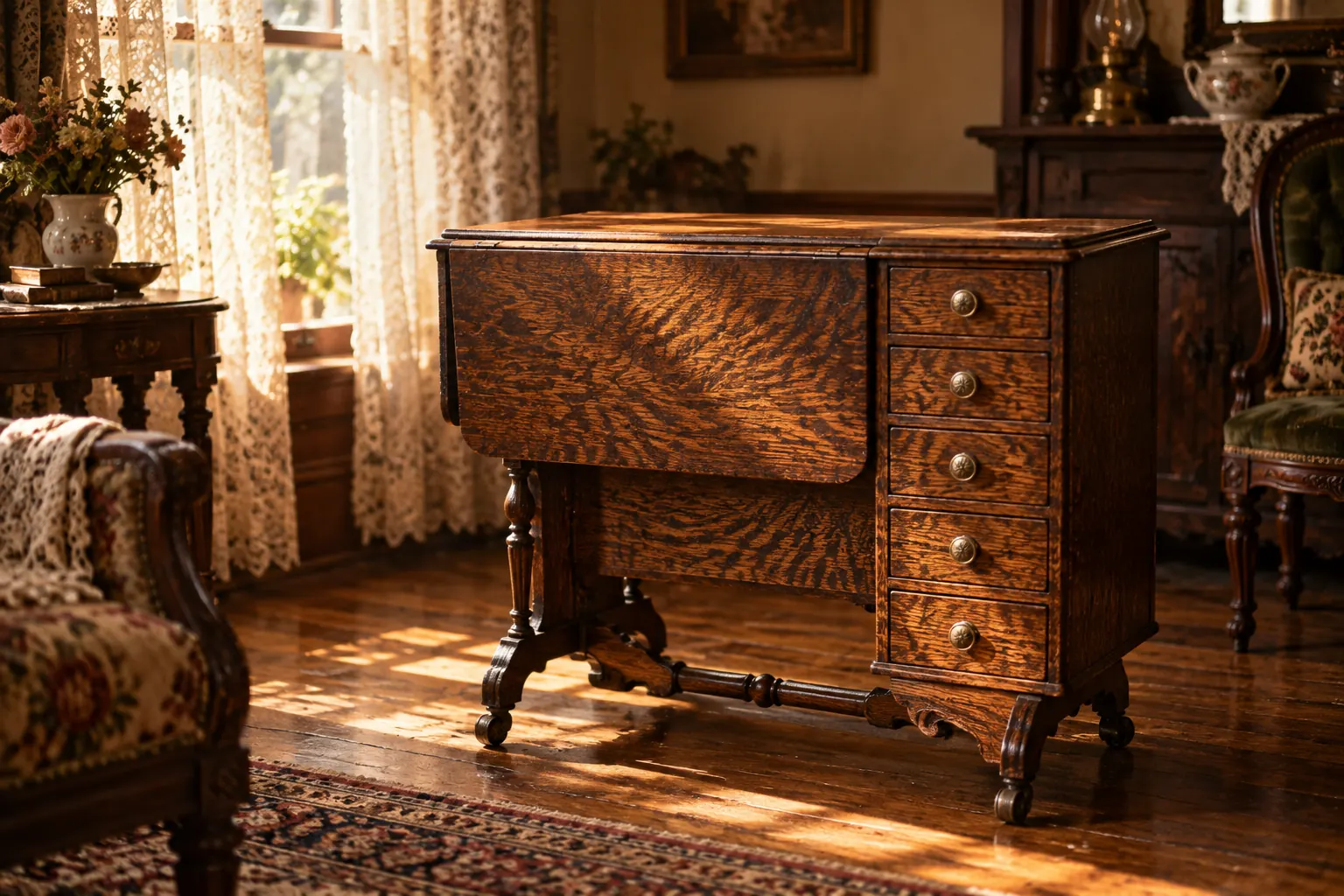
The head hinges down inside the table and a leaf closes over it. Singer listed 3-, 5- and 7-drawer tables in oak, walnut, mahogany, maple and “Mission” finishes. Its 1940 UK list counted the centre tilt section as a drawer.
Electric library table
From 1918–19
A table that passes for furniture, worked by a knee controller. singersewinginfo dates Singer’s electric library tables to 1918 (Set 30) and 1919 (Set 17). Set 40, about 1926, added extension leaves at both ends.
Enclosed cabinet
Nos. 46 and 51
The machine lowers inside and doors close over it. The No. 46 has a one-piece door. The pre-war No. 51 has two doors and a D-shaped drawer.
Card and utility tables
Late 1930s–early 1960s
Folding tables, Nos. 308–316, made for the Featherweight. The table and its machine insert carry matching serial numbers.
ReferenceNumbered Singer cabinets
ISMACS keeps an index of named and numbered Singer cabinets with photographs. These are the ones with clear descriptions. ISMACS gives no dates for most of them, and we haven’t added any.
| Cabinet | What it looks like | Machines and dates |
|---|---|---|
| No. 40 Queen Anne | Curved legs and a burl-walnut top leaf | Not dated by ISMACS |
| No. 40 | Walnut, mahogany or brown Mission; doubles as a writing or library table | Listed for models including the 301-1; singersewinginfo dates Set 40 to about 1926 |
| No. 42 | Desk style with four drawers, an inkwell and a pencil tray | Not dated by ISMACS |
| No. 48 | Doors, a spool rack and hinged drawers | 201 only |
| No. 51 | Enclosed, with two doors and a D-shaped drawer | Before the Second World War |
| No. 68 | Maple, “Early American” style, with an oval top | Featherweight 221; design patent granted 18 February 1947 |
| No. 72 | Walnut, with one centre drawer | 15, 66, 115, 127 |
| Copenhagen 351W | A Danish-inspired desk in walnut veneer | Not dated by ISMACS |
| Nos. 308–316 | Folding card and utility tables with a machine insert | Featherweight; late 1930s to early 1960s |
Sources vary on the No. 40. singersewinginfo dates Set 40 to about 1926, while ISMACS lists a No. 40 cabinet for the 301-1, a 1950s machine. The number seems to have stayed in use for decades, so don’t date a cabinet by its number alone.
Treadle standsReading a cast-iron treadle base
- Look for the name. Later Singer stands have SINGER cast into the rear cross brace. Sewalot notes that in 1870 Singer had not yet put its name on the treadle.
- Look at the legs. An early 20th-century 7-drawer Singer in the Smithsonian has lattice-pattern legs, a double oval framing the shuttle, needle and thread logo, and the words “THE SINGER MANFG. CO.”
- Look at the treadle plate. The same example has a lattice treadle, a pitman drive and rollers on the feet. The Smithsonian’s 1858–59 stand is decorated with an ivy-leaf motif.
- Iron or wood? By the 1930s–40s Singer UK was replacing iron legs with wooden ones for home buyers; a 1951 brochure says wooden stands had replaced them, though an iron-stand drop-head was still offered.
We don’t publish a year-by-year chart of iron leg patterns, because we haven’t found a reliable published chronology. If you know of one, tell us.
For the parts of a treadle and how to keep one running, see our treadle sewing machine guide.
DatingClues for dating a cabinet
- The head’s serial number sets the earliest date the outfit can have been put together as it is now.
- The cabinet number or style, checked against the models ISMACS lists it for. The No. 48 was made for the 201 only, and the No. 68 for the Featherweight.
- A knee controller means an electric cabinet. singersewinginfo dates Singer’s first electric library tables with knee controllers to 1918–19.
- Hardware stamped Simanco, with Singer part numbers, as recorded on the No. 68.
- Wood and finish. Singer’s set codes covered oak, walnut, mahogany, maple and Mission finishes.
ValueIs the cabinet worth anything?
ISMACS publishes no valuations and warns that it’s “a mistake to rely on any price guide”. Most 20th-century machines and cabinets survive in large numbers, which keeps prices down, but a beautiful cabinet “may well have decorative value”, and condition can change value “by many hundreds of percent”.
The exceptions are rare pieces. ISMACS describes the Featherweight No. 68 cabinet as elusive, with only about a dozen examples known and one reportedly offered at $2,500.
To see what tables like yours actually sell for, choose “Singer sewing cabinet” in our sold-price finder and add the drawer count or cabinet number.
ReuseRepurposing a treadle base
Plenty of treadle bases end their working lives as hall tables and desks. If that’s your plan, make changes you can undo. TreadleOn has guides to fitting a new top over a treadle and to restoring an old finish without stripping it.
A treadle can also be electrified. Singer’s own convertible base kit used controller 194386; ornate iron bases need a different bracket from the later straight-leg ones (oldsingersewingmachineblog).
Before you buyWhat to check on a Singer table or cabinet
Cabinet checks
QuestionsFrequently asked questions
How old is my Singer sewing machine table?
Start with the machine head: its serial number gives the year. Then use the cabinet’s style, number, controller and hardware as supporting clues. The furniture may be older or newer than the head, because heads and cabinets were often re-paired.
Where is the number on a Singer cabinet?
There is no single place that every source agrees on. Look under the lid, inside the drawers and on the base, and compare the style with the photos in the ISMACS cabinet index. A number alone doesn’t date a cabinet: No. 40 appears across several decades.
What is a drop-head sewing cabinet?
A table in which the machine head hinges down out of sight and a leaf closes over it, so the piece looks like ordinary furniture. Singer made them on treadle stands and, later, as electric cabinets.
Are old Singer sewing machine tables worth anything?
Some are. ISMACS notes that a beautiful cabinet may have decorative value, but most survive in large numbers and condition can change value by many hundreds of percent. Check sold prices for the same style with our sold-price finder.
Can I turn a treadle base into a table?
Many people do. If you can, keep the original parts and make changes you can undo, such as a new top fitted over the original, so the base can sew again later.
Did White and Kenmore make sewing cabinets too?
Yes. White supplied Sears from the mid-1920s and was its sole supplier by the early 1930s, so many Kenmore and Franklin machines and their cabinets were made by White (ISMACS). Date those with White’s records, not Singer’s.
ReferencesSources
Where sources disagree we show both. Spotted an error? Tell us.
- ismacs.net/singer_sewing_machine_company/singer_sewing_machine_cabinets.html
- www.singersewinginfo.co.uk/tables
- ismacs.net/singer_sewing_machine_company/40_cab.html
- ismacs.net/singer_sewing_machine_company/40_qa_cab.html
- ismacs.net/singer_sewing_machine_company/42_cab.html
- ismacs.net/singer_sewing_machine_company/48_cab.html
- ismacs.net/singer_sewing_machine_company/72_cab.html
- ismacs.net/singer_sewing_machine_company/singer-351w-copenhagen-sewing-machine-cabinet.html
- ismacs.net/singer_sewing_machine_company/featherweight_fever_those_elusive_featherweight_cabinets_and_tables.html
- ismacs.net/singer_sewing_machine_company/mystery-of-the-singer-model-68-sewing-machine-cabinet.html
- ismacs.net/faq.html
- ismacs.net/sewing_machine_articles/how_much_is_my_sewing_machine_worth.html
- ismacs.net/white/white-sewing-machine-company-history.html
- americanhistory.si.edu/collections/object/nmah_1155359
- nmaahc.si.edu/object/nmaahc_2011.12.18.2.1
- sewalot.com/singer_through_the_ages.htm
- oldsingersewingmachineblog.com/2011/11/20/vintage-singer-cabinets-treadle-bases-and-1929-uk-prices
- oldsingersewingmachineblog.com/2011/12/29/singer-uk-brochure-and-price-list-1940
- oldsingersewingmachineblog.com/2011/11/02/the-singer-enclosed-cabinet-no-51
- oldsingersewingmachineblog.com/2012/04/28/vintage-singer-uk-brochure-featuring-her-with-the-frock-part-two
- oldsingersewingmachineblog.com/2012/08/09/the-singer-convertible-treadle-base-and-motor-controller-194386
- www.treadleon.net/woodshop/index.html
Last reviewed October 2026