Key points
- Primary bevel about 25°; hone a microbevel around 30°.
- Grits: 1000 to raise a burr, then 8000; 4000 in between if you like.
- Stones must be flat; flatten them regularly.
- The ruler trick makes a back bevel of under 1° on plane irons only, not chisels.
- Give jack planes more camber than smoothers.
AnglesWhat angle to sharpen a plane iron
A Lie-Nielsen sharpening sheet says its blades come ground at 25° and recommends honing at 30° to create a microbevel, which concentrates your effort on the very edge; regrind the 25° bevel when the microbevel gets large. Not everyone agrees: Derek Cohen, writing for Fine Woodworking, prefers a primary bevel nearer 30° and honing on a hollow grind. Either works; consistency matters more than the exact number.
StepsStep-by-step sharpening
- Flatten the stones. Lie-Nielsen notes stones must be flat; use 100–220 grit wet-and-dry on glass or a diamond plate.
- Flatten the back of the iron near the edge. A pitted or rough back can never be truly sharp, as Thomas Lie-Nielsen puts it.
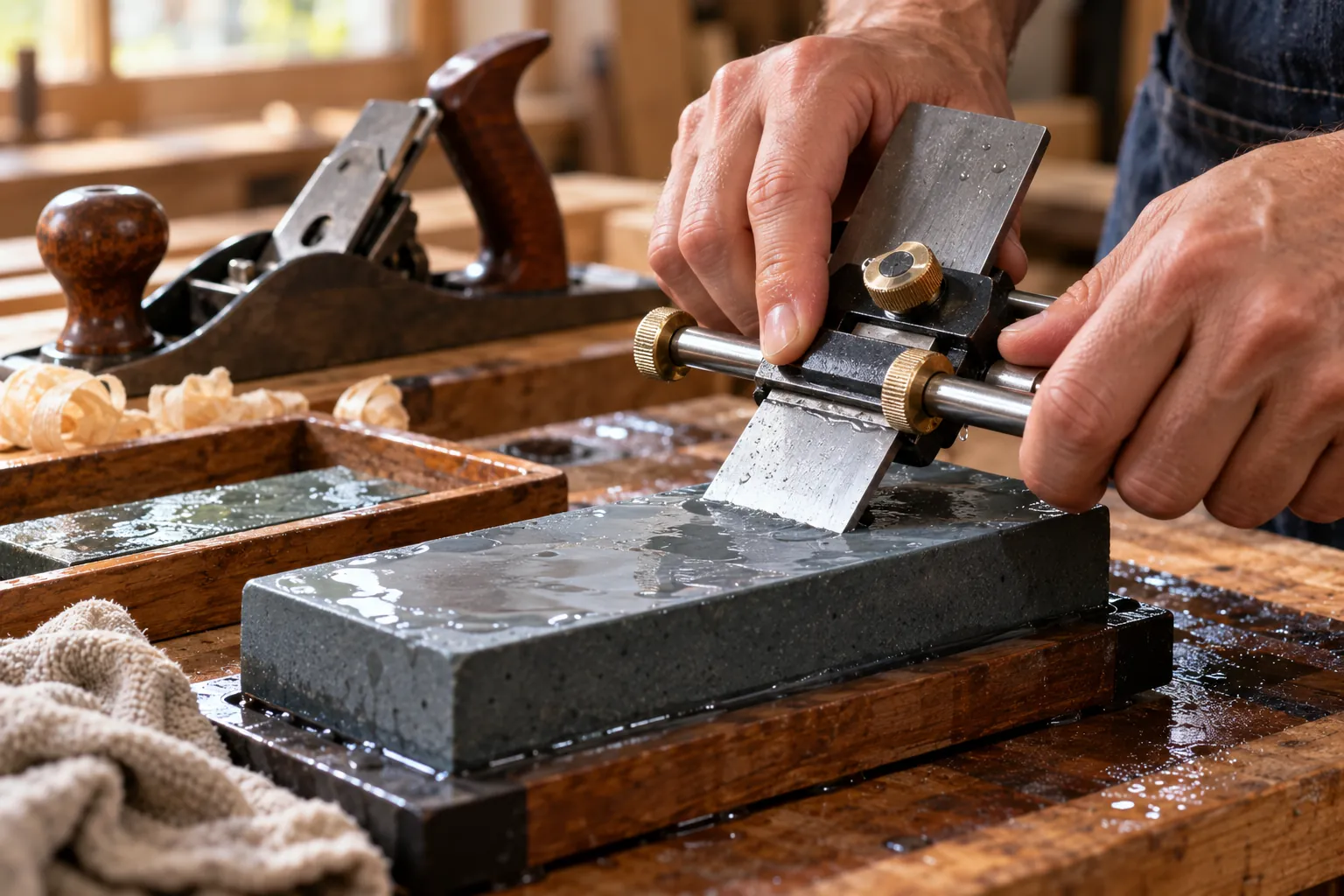
- Set the honing guide. Lie-Nielsen gives projection distances: 2⅛ in for 25° and 1 9/16 in for 30° in a side-clamping guide.
- Hone on 1000 grit until you feel a burr along the whole back edge.
- Refine on 8000 (4000 first if you have it).
- Remove the burr by polishing the back on the finest stone.
Ruler trickThe ruler trick for pitted backs
David Charlesworth’s ruler trick: lay a thin steel ruler along one edge of the fine stone and rest the iron’s back on it, so only the first fraction of the back touches. It creates a back bevel of less than 1°. Axminster points out it is only for plane irons, never chisels, whose back is the reference surface.
CamberCamber for jack and smoothing planes
A slightly curved edge stops the corners leaving tracks. Rob Porcaro aims for shavings thickest in the middle, about .001 in, on a smoother; a jack plane gets more camber so it can take thick shavings without gutters. Then set up the plane.
QuestionsFrequently asked questions
What angle should a plane iron be sharpened at?
Commonly a 25° primary bevel with a 30° microbevel; some prefer about 30° as the primary.
What grit do I need to sharpen a plane blade?
About 1000 to raise a burr and 8000 to polish, with 4000 optional in between.
Do I need a honing guide?
Not strictly, but it makes consistent angles much easier, especially when learning.
Can I use the ruler trick on chisels?
No. Its back bevel suits plane irons only.
ReferencesSources
These are the pages and manuals the facts in this article come from. Where they disagree, we say so in the text.
- info.highlandwoodworking.com/blog/sharpening2.pdf
- www.finewoodworking.com/project-guides/hand-tools/a-sharpening-strategy-beyond-a-sharp-edge
- www.finewoodworking.com/project-guides/handplanes/sharpening-a-plane-iron-with-a-pitted-back
- knowledge.axminstertools.com/plane-iron-sharpening-with-the-ruler-trick
- en.wikipedia.org/wiki/Sharpening_stone
- www.finewoodworking.com/2010/07/23/how-much-camber-should-be-in-plane-irons
- blog.lostartpress.com/2013/05/18/sharpening-a-plane
Published 24 October 2026 · Written and fact-checked by the HeirloomID editors. Spotted an error? Tell us.