Key points
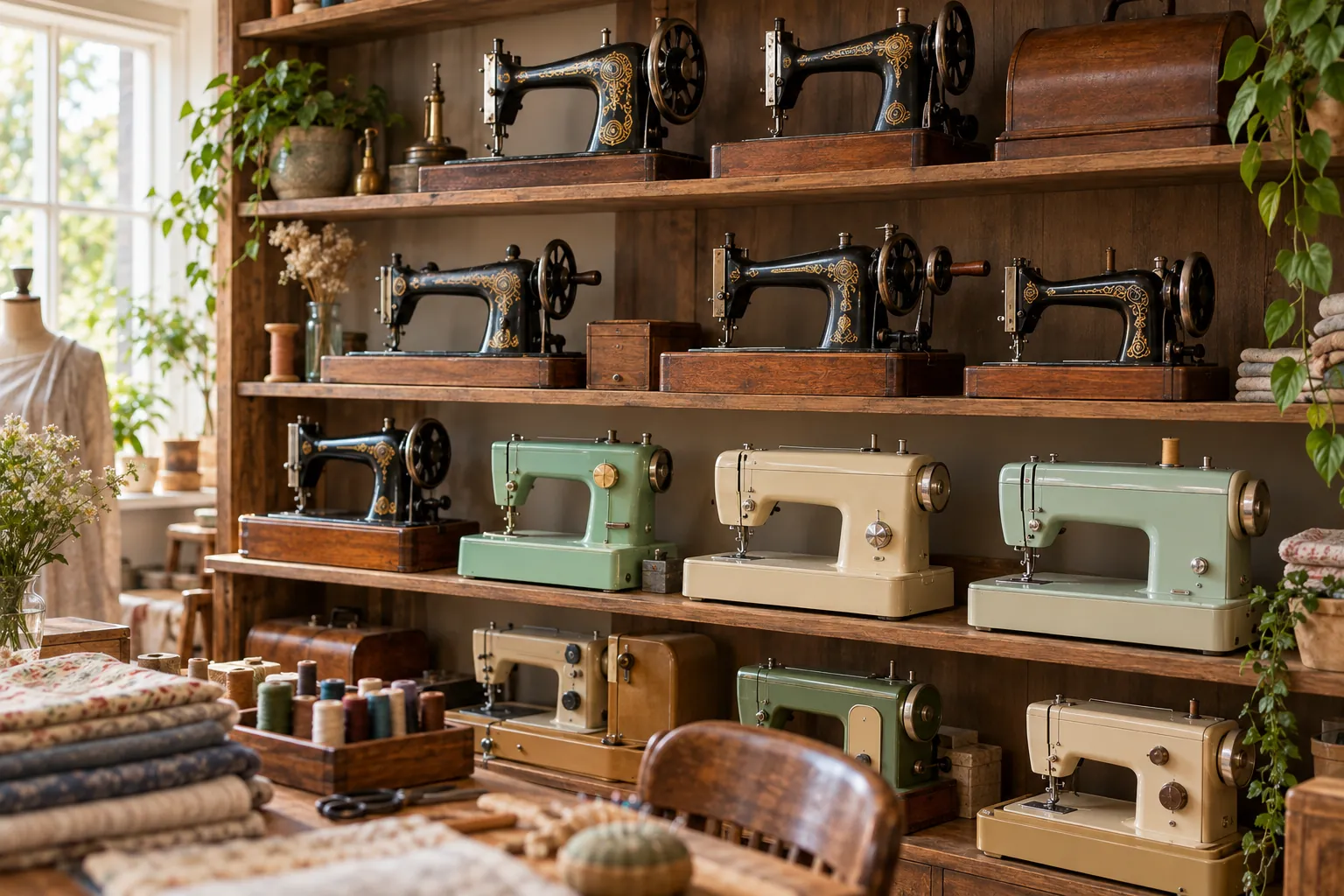
- 1900s–1920s: black japanned cast-iron machines such as the 15, 66, 99, 27 and 127, often treadle or hand-crank.
- 1930s: the gear-driven 201 and the 221 Featherweight portable.
- 1940s: few new models; domestic production stopped at Elizabethport from 1942 to 1945.
- 1950s: the 301, 222K, 401A, 403A and 404, with beige and two-tone finishes.
- 1960s–70s: the 500A Rocketeer, the Touch & Sew series and, by the 1970s, more plastic.
At a glanceWhich Singer models belong to which decade?
| Decade | Typical models | What they look like |
|---|---|---|
| 1900s | 66 (from 1902), 27/28, 15 | Black japanned cast iron, gold decals, treadle cabinets |
| 1910s | 99 (from 1911), 66 Red Eye, 127/128, toy Model 20 (1910) | As above; first electrics later in the decade |
| 1920s | 66, 99, 127/128, 15, Portable Electric (1921) | Black; knee-lever and external motors become common |
| 1930s | 201 (1934), 221 Featherweight (1933/34), 15-91 | Black; gear-driven ‘potted’ motors; plainer decals |
| 1940s | 15-91, 201, 66, 99, 221 | Black; war gap 1942–45; crinkle finishes |
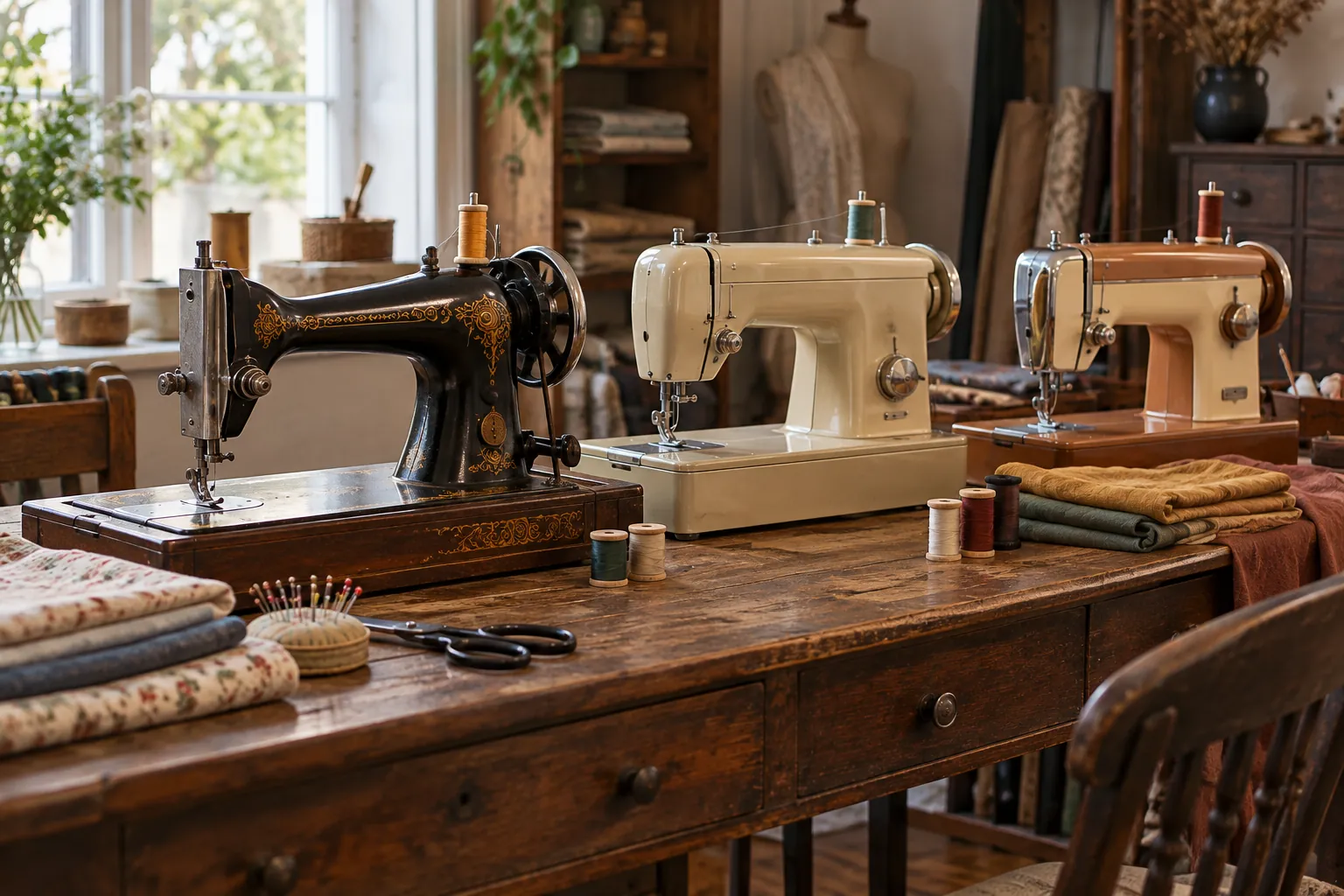
| 1950s | 301 (1951), 222K (1953), 401A (1956/57), 403A/404 (1958), 185 (1958) | Black or beige, two-tone tan and cream, aluminium bodies |
| 1960s | 500A Rocketeer (1961), 503A, Touch & Sew 600 series (1965) | Mid-century styling; zigzag and built-in stitches |
| 1970s | Later Touch & Sew, Athena 2000 (1975), Touchtronic 2001 (1978) | Plastic covers, nylon or plastic gears, electronic controls |
1900s–1920sSinger sewing machines from 1900 to 1930
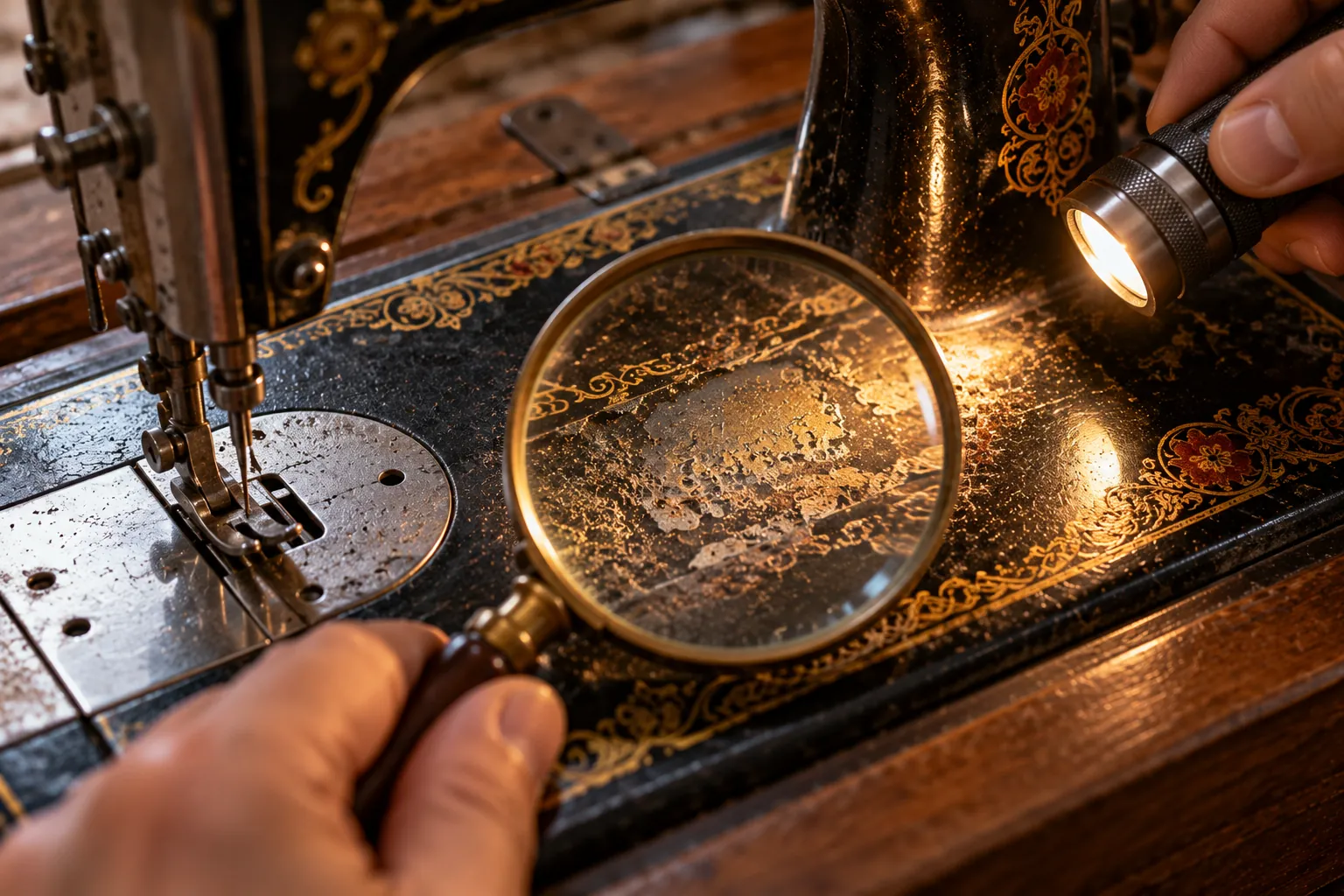
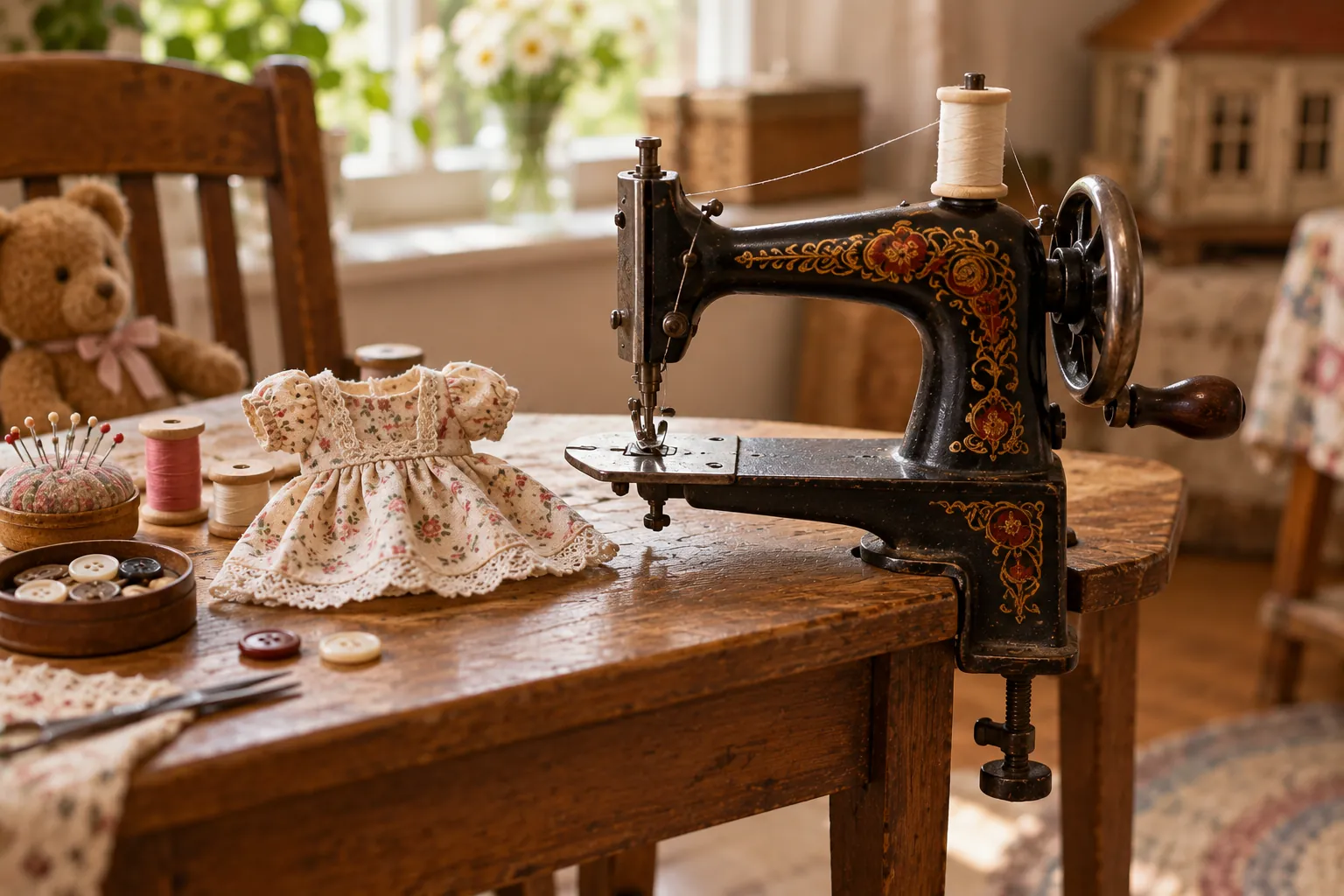
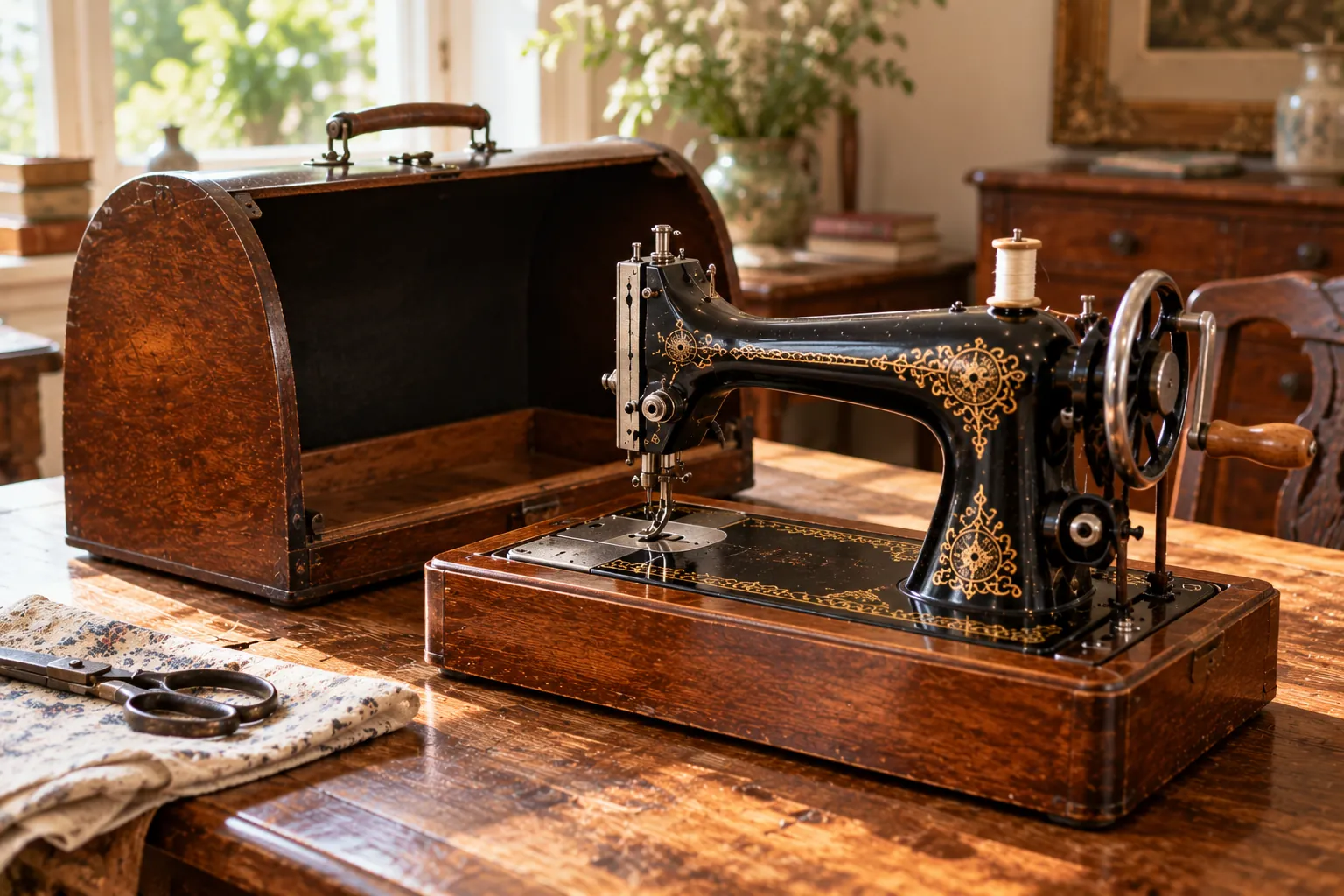
A Singer from 1910 or 1920 is the classic “antique Singer”: black japanned cast iron with gold decals, usually in a treadle cabinet. The full-size Model 66 arrived around 1902 with a drop-in bobbin, and the three-quarter-size Model 99 followed in 1911. The long-shuttle 27 and 127 carry the famous Sphinx decals. Singer’s timeline dates its Portable Electric to 1921, and from the 1920s many machines were sold with an external motor and a knee lever.
Decals help place these machines: the 66 “Red Eye”, the Sphinx, Tiffany and Victorian patterns all belong to known periods. See our decal guide.
1930s–1940sSinger sewing machines from the 1930s and 1940s
The 1930s brought two of the most admired Singers. The 201, introduced in 1934, has a full rotary hook and gear drive; singersewinginfo calls it Singer’s finest domestic machine. The aluminium 221 Featherweight, first commissioned in October 1933, weighs about 11 lb. The 15-91 put a ‘potted’ motor in the back of the pillar.
A 1940 or 1940s Singer is usually one of these models, or a 66 or 99. There are few 1943–45 domestic machines from Elizabethport, because the factory made munitions from June 1942 to July 1945.
1950sSinger sewing machines from the 1950s
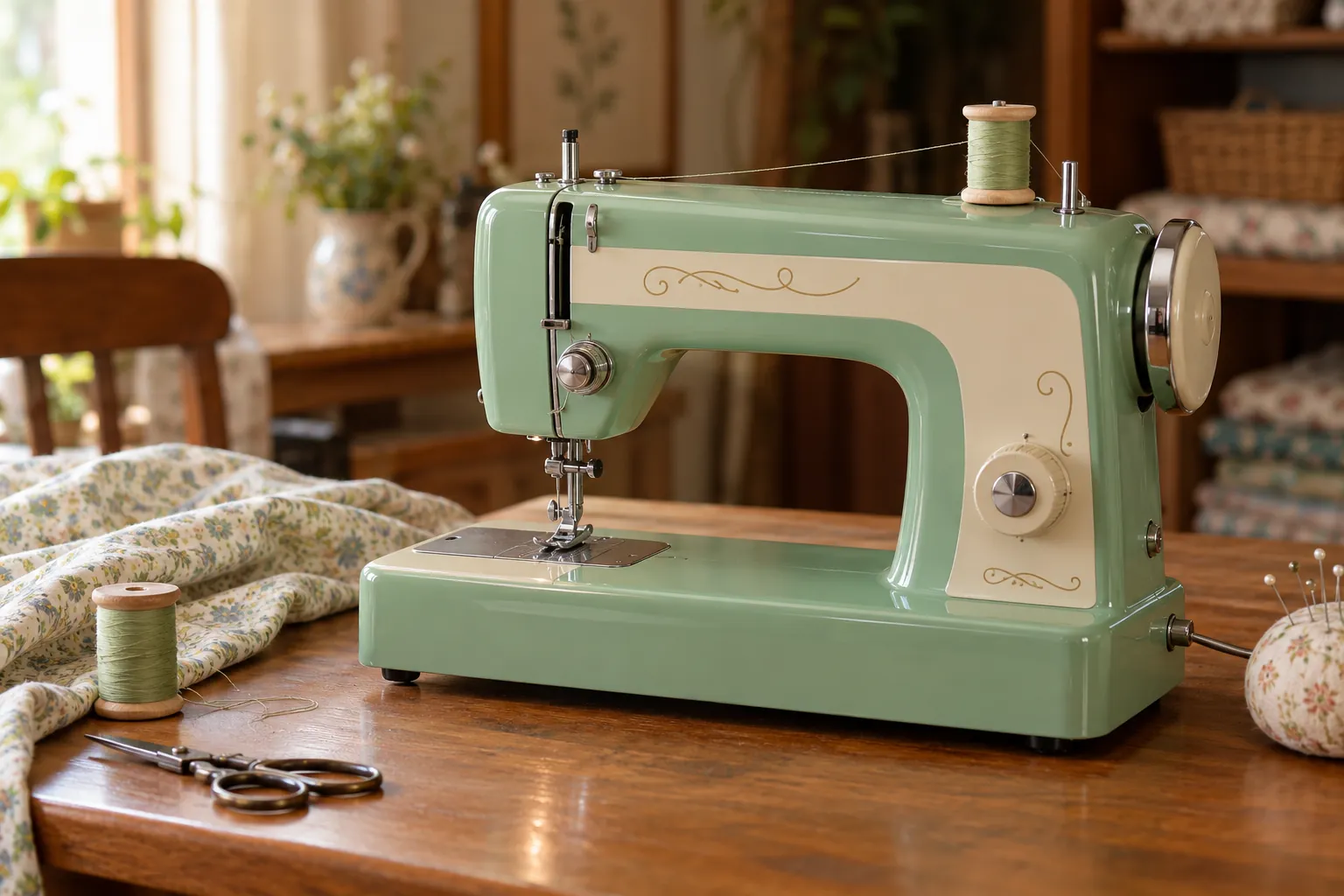
The 1950s is the decade of change. Singer opened its Anderson, South Carolina plant, which built the slant-needle 301 from 1951. The free-arm 222K followed in 1953 for markets outside the US. The 401A Slant-o-Matic (1956 or 1957, depending on the source) added built-in zigzag and decorative cams, and the 403A and 404 appeared in 1958. Finishes moved from black to beige and two-tone tan and cream. A “1950 Singer” or “1951 Singer” in a wooden cabinet is very often a 15-91, 201-2 or 66.
1960s–1970sSinger sewing machines from the 1960s and 1970s
The 500A Rocketeer (1961–63) is the last of the all-metal slant-needle line. The Touch & Sew series, released in 1965, introduced a push-button bobbin. On these and later machines, oldsewingear.com warns that black plastic gears are prone to cracking with age; white nylon gears are better, but not as durable as steel. Singer dates its first electronic machine, the Athena 2000, to 1975 and the computerised Touchtronic 2001 to 1978.
If you want a vintage Singer to sew with, our guide to the best vintage Singers explains which decades to look at.
Your machineHow to tell what year your Singer is
Model and decade narrow it down; the serial number pins it. Find the number stamped on the bed and enter it in our serial number lookup. If you can’t find it, see how to date a Singer without a serial number.
QuestionsFrequently asked questions
What Singer sewing machines were made in the 1950s?
The main 1950s models were the 15-91, 201-2, 66 and 99K, joined by the 301 (1951), 222K (1953), 401A (1956/57), 403A and 404 (1958) and 185 (1958).
What Singer sewing machines were made in the 1960s?
The 401A, 403A and 404 continued into the early 1960s, followed by the 500A and 503A (1961–63) and the Touch & Sew series from 1965.
What does a 1920s Singer sewing machine look like?
Black japanned cast iron with gold decals, usually a 66, 99, 127 or 15, often in a treadle or a cabinet with a knee lever and external motor.
Are 1970s Singer sewing machines good?
Many are usable, but several 1970s models rely on plastic or nylon gears that can crack with age. Earlier all-metal models are generally more durable.
How do I find the exact year of my Singer?
Look up the serial number stamped on the machine bed. It gives the year the number block was allotted.
ReferencesSources
These are the pages and manuals the facts in this article come from. Where they disagree, we say so in the text.
- www.singersewinginfo.co.uk/singer_machines/domestic_machines/models/15
- ismacs.net/singer_sewing_machine_company/singer-class-66-sewing-machine.html
- www.singersewinginfo.co.uk/singer_machines/domestic_machines/models/99k
- www.singersewinginfo.co.uk/201
- en.wikipedia.org/wiki/Singer_Featherweight
- www.singersewinginfo.co.uk/history/factories/anderson
- www.singersewinginfo.co.uk/404a
- www.oldsewingear.com/601--603-604.html
- www.singer.com/pages/singer-history
- www.singersewinginfo.co.uk/history/factories/elizabethport
Published 24 October 2026 · Written and fact-checked by the HeirloomID editors. Spotted an error? Tell us.